
Family Tree
Family Tree Magazine is a leading family history magazine published by ABM. Available from all good newsagents. Click here to subscribe. Getting the 1911 Census online
The wealth of historical records online have made family history much more popular and easier too. Here Family Tree talks to Mark Bayley, senior web developer at TheGenealogist.co.uk, about the feats of technology and teamwork needed to make online genealogy possible.
How to Search the 1911 Census on TheGenealogist.co.uk
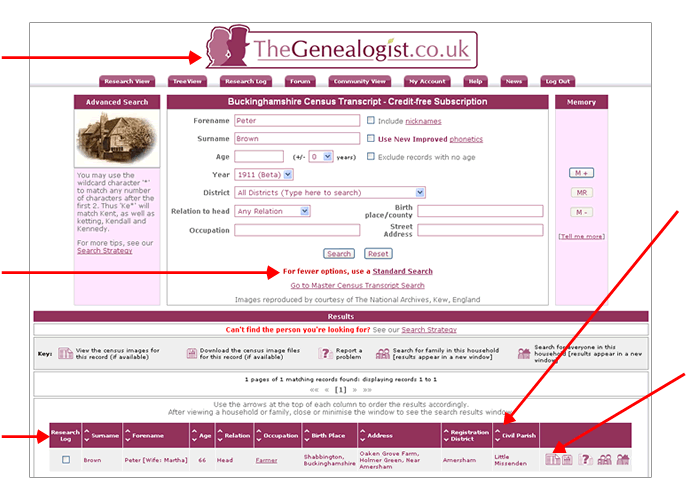
| Go to www.the genealogist.co.uk, select Buckinghamshire from the list of census transcripts, then select 1911 Census and enter your search terms. |
 |
|
||||
| This is the advanced search, which shows all the fields that you can search on. There is also a standard search. | ||||||
Your search results will appear below. |
The census is being much celebrated this year and TheGenealogist.co.uk and Ancestry.co.uk have joined forces so that they will be able provide their subscribers with access to indexes and original images of the 1911 Census for England and Wales. Here we investigate the huge 1911 Census project in progress at TheGenealogist.co.uk, to see what's been happenning and what's in store.
Q. The pages of the 1911 Census have already been digitally scanned, so what are the next steps that need to happen, to make the files into an online searchable database?
A. The images we received from The National Archives (TNA), owners of the original 1911 Census collection for England and Wales, were 'raw' files. This meant that they needed to be processed to go online so that the files were small enough for users to download.
We have a two-step process unique to our site that means for the first time users will be able to view a quick loading file and have the option of viewing a high-resolution version, with more quality and twice the resolution than has previously been available online.
At the same time, our transcription department tackles the task of keying in each individual's details, which are then fed into our large transcript database. The next step is to add the transcript records so that they become searchable using our unique tools:
- the keyword master search
- the family forename search
and the house and street search.
We then begin the alpha-testing stage in-house. This is followed by beta-testing with some of our users.
Q. How many bytes will the entire 1911 Census take up?
A. Including multiple versions (the quick-loading file, the high-resolution version and back-ups), arouns 200 terabytes*.
(*A terabyte is 1,048,576 megabytes - so the 1911 Census will take up 209,715,200 megabytes!)
Q. Was it difficult to decide on the level of detail and the number of search fields to include in your search window?
A. Not really, we pride ourselves on providing full transcripts to make it easier and quicker for our users to find their ancestors, so there was very little that we decided not to transcribe.
Q. Will the transcriptions be double-checked to help make for more accurate search results?
A. All transcriptions go through two levels of quality assurance before going online.
Q. Is this the biggest single project that you have ever taken on?
A. Pretty much, and it's definitely bigger than any single year of the census we have done before.
A. The sheer volume of images, as there are now two images per household, totalling more than 16 million images. With earlier census returns, however, a single page image could list several households, maybe even half a street.
Q. How many people are working on the project?
A. Hundreds.
Q. When will the redacted information in the disability column become publicly accessible?
A. The Information Commissioner's Office rules that the disability column had to be hidden for the full 100 years. TNA will be sending us unredacted images early next year and we shall be processing them and uploading them to the website as soon as we get them.
Q. What's your favourite aspect to the project?
A. Finding my ancestors when doing the beta-testing. It's always satisfying seeing my ancestors there in high-resolution colour and reading their handwriting for the first time.
Q. What is the order of release for the counties?
A. The order has not yet been finalised, but the next area to be released is going to be London, and Buckinghamshire is already available on the website.
| This is the high resolution image of the 'Household' view and it is impressively sharp. You can also view images in medium resolution to speed up viewing and download time. | The 1911 Census is known as the 'fertility census' as it asked so many questions about a woman's children. | ||
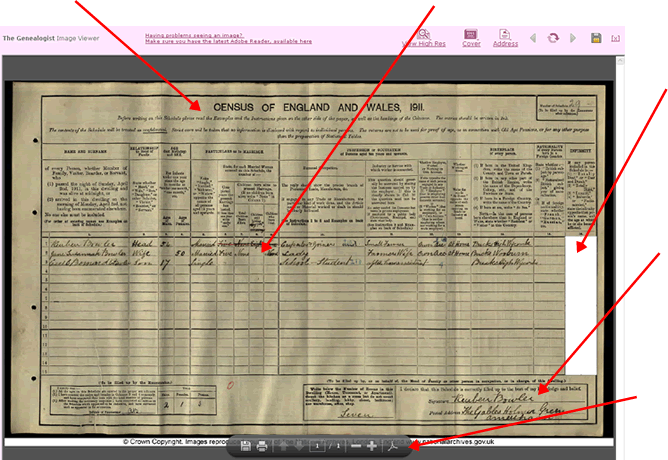 |
This white space is the redacted information, which will not be accessible to the public until early 2012. | ||
| See the signature of the ancestor that filled in the form. | |||
| To display the Acrobat Reader X tools (to save, print, zoom, etc), hover your mouse near the bottom of the window. Selecting the symbol on the far right will display the tools permanently at the top of the census window, making them immediately accessible. | |||
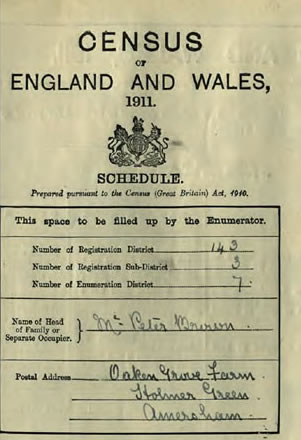
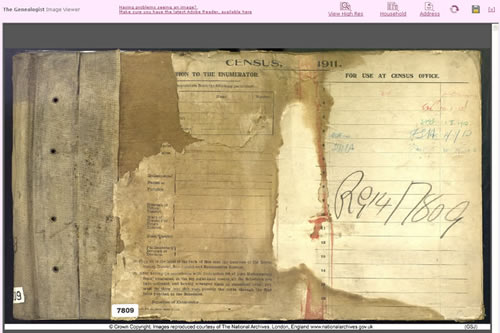
Selecting 'Address' displays the address sheet Selecting 'Cover' reveals the cover of the enumerator's summary book |
 |
 |